Is AI Infrastructure the New EV - Already Obsolete?
AI hardware generations turn over every 18 months. But the real risk isn't that the chips stop working - it's that the economics shift underneath you before your depreciation schedule catches up.
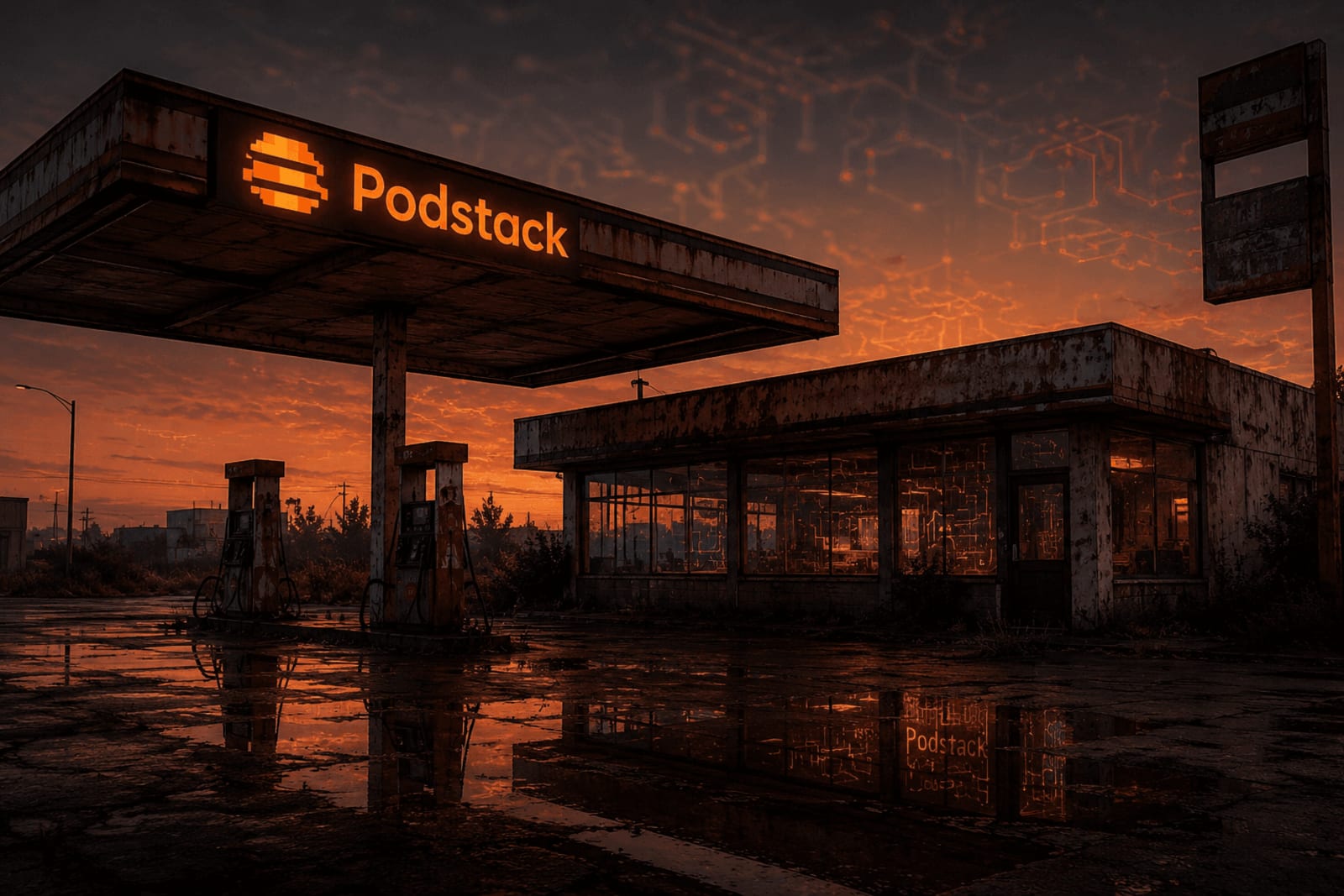
Every generation, a new technology earns the label of "stranded asset." Electric vehicles rewrote the calculus for gas-station networks. Streaming obsoleted the DVD rental industry overnight. Now the question is whether the billions being poured into AI data centers share the same fate.
The analogy to EV technology is seductive. Both sectors feature hardware generations that compress years of improvement into months. Both have seen incumbents scramble to retrofit old infrastructure for new demands. And both carry the uncomfortable possibility that today's flagship investment is tomorrow's liability.
But the analogy frays under scrutiny - and understanding exactly where it breaks down is key.
Where the Comparison Holds
Nvidia's GPU roadmap is the clearest proxy. The A100 (2020) was the undisputed training champion. Within two years, the H100 made it economically inferior. The H200 followed. The B200 is now state-of-the-art - on an 18-month cadence that shows no signs of slowing.
For organizations that purchased AI compute on a CapEx basis - building private data centers, buying physical racks - this pace represents genuine obsolescence risk. Not because the hardware stops working, but because training next-generation models demands architectures it cannot support.
Power infrastructure compounds this. As model training pushes toward gigawatt-scale consumption, data centers built for earlier power densities face retrofit costs that rival the original investment.
Where the EV Analogy Breaks Down
Unlike an EV battery pack - a physical assembly that cannot be firmware-updated into a different chemistry - AI infrastructure is fundamentally software-defined. The same GPU cluster that trained a model in 2023 can run inference workloads in 2026. The compute doesn't expire; it gets redeployed.
More importantly, the dominant model of AI infrastructure consumption is cloud-based OpEx, not on-premises CapEx. When AWS or Azure absorbs the hardware refresh cycle, the enterprise customer is insulated from the churn. What was existential for the gas station owner is a rounding error for the driver paying at the pump.
The Hidden Obsolescence: Economic, Not Physical
The subtler and more dangerous form of obsolescence is economic, not physical. Older chips don't stop functioning - they become uncompetitive. H100 clusters get repriced into inference workloads where their cost-per-token still makes sense.
But for organizations sized around CapEx models - sovereign AI initiatives, startups that bought rather than rented - the math is unforgiving. The next model generation requires 5–10x the compute of the previous one. If your infrastructure can't scale, you're running yesterday's AI at today's prices.
This is the gas-station-in-2015 problem. The station wasn't broken. The economics were broken.
Who Is Actually Exposed?
The exposure is concentrated. Cloud-native organizations consuming AI as a service carry minimal direct risk - their providers absorb the generational churn. The exposed parties are those who made large, fixed bets on specific hardware: governments building sovereign AI capacity, enterprises running private AI clouds, and the hyperscalers themselves.
The hyperscalers aren't naive about this. Microsoft, Google, and Amazon structure hardware procurement as a rolling refresh - never fully committed to one generation, always hedging into the next.
The Correct Mental Model
The most accurate frame isn't EV batteries - it's semiconductor fabs. A fab built for 28nm didn't break when 7nm arrived. It became economically inferior for some workloads and superior for others. The asset didn't disappear; it found its level in a tiered market.
AI infrastructure will follow the same pattern. H100 clusters become inference workhorses. A100s handle fine-tuning. The cutting edge advances; the previous generation reprices, not vanishes.
The risk is not obsolescence in the EV sense. The risk is being caught holding a CapEx position the market reprices faster than your depreciation schedule. That's a financial risk masquerading as a technology risk - and it requires sophisticated hedging, not panic and not complacency.

Saurav Kumar · Founder
Saurav leads Podstack's vision and strategy, driving the company's mission to make GPU cloud infrastructure accessible to every ML team. With deep experience in cloud computing, infrastructure engineering, and business operations, he oversees product direction, partnerships, and company growth. His passion for democratising AI compute powers Podstack's commitment to delivering high-performance GPU resources at competitive pricing.
Related posts
How to Generate Multilingual Video Ads with ComfyUI, Wan 2.2, and Sarvam AI
Turn a single English brand prompt into a 30-second vertical video ad in six Indian languages. This tutorial wires ComfyUI, Wan 2.2 video diffusion, and Sarvam AI's Indic LLM and TTS into one reproducible pipeline.

How To Fine-Tune an LLM with Unsloth Studio on Podstack
Learn how to fine-tune a large language model using Unsloth Studio on Podstack. This step-by-step tutorial covers deploying a one-click GPU pod, configuring a QLoRA run on TinyLlama, monitoring training, and exporting your fine-tuned model — no Python scripts required.

Podstack vs. Runpod vs. CoreWeave: Which Cloud GPU Platform Should You Choose in 2026?
Runpod, CoreWeave, and Podstack are often compared but serve very different users. We break down GPU selection, pricing, deployment, compliance, and community to help you pick the right cloud GPU platform for your AI workloads.